
After opting for status quo in policy rates, Reserve Bank Governor Raghuram Rajan on Tuesday said any more cut will depend on further transmission of previous rate cuts by banks, softening in inflation and progress of monsoon.

The Reserve Bank's rate-setting panel will start its 3-day deliberations on Wednesday amid expectations of yet another rate hike of 50 basis points to check high inflation, in line with similar actions taken by other major central banks, including the US Fed. Based on the recommendations of the Monetary Policy Committee (MPC), the RBI had effected 50 basis points increase in repo rate each in June and August after raising the short-term lending rate by 40 basis points in an off-cycle decision in May. The MPC, headed by RBI Governor Shaktikanta Das, is scheduled to meet during September 28-30.

Though on a downward curve, economists warn of inflationary pressures still existing in the system which might prevent the Reserve Bank from going in for rate cuts over the next three months. "The RBI is targeting an inflation level of 5-5.5 per cent. If, however, it continues to remain in double digits till January, then the tight monetary policy would continue," Crisil Director and Principal Economist D K Joshi said.

rediffGURU Ramalingam Kalirajan answers your personal finance queries.

Ahead of the 2023-24 Union Budget, the thinking at the top level of the central government is clear: Gross domestic product (GDP) growth of 6-6.5 per cent is a comfortable enough target for FY24 and the focus should be on fiscal consolidation to ensure that the sovereign cost of borrowing does not become prohibitively expensive in a high-interest rate environment, according to people in the know. Those aware of deliberations between the Prime Minister's Office (PMO) and the Ministry of Finance said while the Budget would look to strike a balance between infrastructure investment and welfare schemes, it is unlikely to be populist, though it will be the last full-year Budget before the 2024 Lok Sabha election. Incidentally, 6-6.5 per cent GDP growth is what the upcoming 2022-23 Economic Survey is expected to project for FY24.

Battling a sharp surge in inflation, the Reserve Bank is all for a smooth monetary policy response and the desire to have smaller hikes led it to tighten the policy in an off-schedule meet, a source said on Thursday. Inflation has been massively impacted by Russia's invasion of Ukraine and will in due course also reflect the dent caused by Indonesia banning palm oil exports, the source aware of central bank thinking said, indicating that there was no other option but to respond. "The idea is to have a smooth policy response, not to put in large cold turkey responses," the source said, making it clear that the preference is for smaller magnitude responses and not larger ones.
Unfazed by the rising inflation at over 6.0 per cent, Finance Minister Jaswant Singh said on Wednesday that the government was confident it would be contained at 4-4.5 per cent annual average by March end, as projected by the Reserve Bank of India.\n\n

Patel urges government to rein in borrowings, inflation

The stock has gained over 10 per cent in the last month but it could still have an upside, with valuations between Rs 5,200 and Rs 5,700 from several analysts and strong 'buy' consensus.

Bihar Chief Minister Nitish Kumar on Tuesday announced his intent to raise quotas for Other Backward Classes, Scheduled Castes and Scheduled Tribes in the state, saying a legislation to the effect is likely to be brought in the ongoing assembly session.
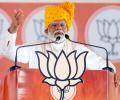
In the coming days, unless Modi tones down the communal spiel, it will be clear that anxiety continues to drive his mind and clouds his judgment, observes Modi biographer Nilanjan Mukhopadhyay.
The surge in inflation is a major cause of concern even for giants like the United States and China and rich nations like Britain and Singapore.

Rajan had overturned the majority opinion of the members and chose to hold the rates at the last monetary policy review in October.

The RBI governor most famous oneliners -- 'I am Raghuram Rajan and I do what I do' -- that eventually summed up the year 2015 for the central bank
The Sensex is likely to scale 24,000 mark by December-end on receding chances of a fractured verdict in the upcoming Lok Sabha elections, lower inflation and improving global risk appetite, German brokerage Deutsche Securities said on Tuesday.

While analysts predicted the Sensex to cross 30,000 in 2016, the index currently stands 12% lower at 26,400.

The excise duty cut will translate into a reduction of Rs 9.5 a litre on petrol and Rs 7 a litre in diesel after taking into account its impact on other levies.

India's August industrial output rose just 0.4 per cent compared with 2.4 per cent estimated in a Reuters poll.

With economic activity still to reach pre-pandemic levels, the RBI may slow down the pace of rate hikes until next year to quell soaring inflation while supporting growth, the Asian Development Bank (ADB) says in its latest report. The Manila-based multilateral funding agency has raised the inflation forecast for the current fiscal year ending in March 2023 to 6.7 per cent from its earlier projection of 5.8 per cent. For the next fiscal year too, the forecast has been revised upwards to 5.8 per cent from 5 per cent earlier.

In the Budget speech, Arun Jaitley had first spoken about the need to have a range.

The FMCG sector is generally considered to be a safe haven during difficult times as people never stop buying soap and toothpaste. However, weak rural and semi-urban demand has been a factor since the lockdowns of 2020-21 while rising inflation has also impacted margins. While the FMCG majors have survived on the basis of price hikes and good management practices, they have seen growth slowdowns and experienced margins being squeezed as raw materials and transport costs rose. The FMCG sector witnessed positive volume growth in the fourth quarter of the 2022-23 financial year (Q4FY23) after five consecutive quarters of decline, and the rebound in demand was led by urban markets.

Noting that the assembly election results being very disappointing is an understatement, the Congress Parliamentary Party chairperson urged party MPs to channel their disappointment into positivity for next year's general elections.
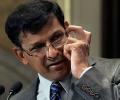
The report also described the RBI as an "extremely visionary, pragmatic and fairly independent" organisation throughout its history

After bumbling for years since 2014, the Modi government seems to believe that massive government expenditure will lead us to prosperity supported by 'seat-of-the-pants' decision-making, observes Debashis Basu.

Factory output in June likely rose 5.4 per cent from a year earlier, faster than the 4.7 per cent growth in May, according to a poll of 27 economists.

Lead indicators suggest that domestic current account deficit (CAD) is likely to reduce in 2023, while macro-economic stability has received a boost from inflation being brought back to the official tolerance band, according to the Reserve Bank of India's (RBI's) January 2023 Bulletin. "With the merchandise trade deficit reaching an all-time high of $83.5 billion in a quarter, and a rise in net outgo from the income account, the current account deficit increased to 4.4 per cent of GDP in Q2FY23," the State of the Economy article in the bulletin said. "It is noteworthy, however, that the CAD for Q1 was revised down from 2.8 per cent to 2.2 per cent on account of downward adjustment in Customs data.

The failure of SVB was due to idiosyncratic reasons, but shows how higher rates can expose fault lines in unforeseen places, observes Neelkanth Mishra.

He will presumably choose to remain true to the framework he has put in place.
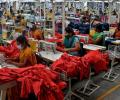
Enthused by higher than expected GDP numbers in the fourth quarter of 2022-23, Chief Economic Adviser (CEA) V Anantha Nageswaran on Wednesday said India's economic growth may exceed the initial estimate of 6.5 per cent in the current fiscal and the country can look for another year of solid economic performance.

Tata Motors was the biggest loser in the Sensex pack, skidding 1.77 per cent, followed by SBI, Power Grid, Tata Steel, Infosys, UltraTech Cement, Titan, Larsen & Toubro, Reliance Industries and Maruti. On the other hand, IndusInd Bank, Bharti Airtel, Asian Paints, NTPC, HCL Technologies, HDFC and Sun Pharma were the gainers.
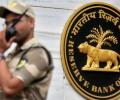
With retail inflation surprising on the upside, the six-member monetary policy committee (MPC) of the Reserve Bank of India (RBI) is expected to increase the repo rate by 35-50 basis points (bps) in the review scheduled for September 28-30. According to economists, the central bank will continue to focus on bringing inflation down even though economic growth has remained sluggish. Data released by the government on Monday showed that the consumer price index (CPI)-based inflation increased by 7 per cent year-on-year (YoY) in August, thus, staying above the upper tolerance limit of the central bank for all the eight months of 2022.

Consumer food price inflation eased to 6.14%.

The challenge is to enhance opportunities for people to generate livelihoods through entrepreneurship, both big and small, argues R Jagannathan.

The 'black paper', titled '10 saal anyay kaal' also alleged that issues such as rising prices, unemployment, subversion of institutions and farmers' 'distress' had plagued the country.

October infrastructure output, which contributes nearly 38 per cent to the industrial output index, was up 3.2 per cent annually.

Full capital convertibility means a foreign investor can repatriate his money into his own local currency at will.

The minister further said the Sri Lankan government is holding continuous interactions with the Tamil diaspora and people and leaders living in different parts of the world.

The government's decision to impose a 20 per cent export duty on parboiled rice and a $1,200 per tonne minimum export price (MEP) on basmati rice has pulled down overseas shipments of the former by almost 83 per cent and around 30 per cent of basmati exports in a month. Data sourced from various trade agencies and shippers showed that between August 25 and September 20, export of basmati rice has shrunk from 342,605 tonnes in 2022 to around 241,083 tonnes in 2023. Similarly, export of parboiled rice, after the imposition of 20 per cent duty during the same period, has dropped from 1.16 million tonnes in 2022 to just around 204,190 tonnes in 2023.

The Indian economy recovered from the Covid-induced downturn during 2022 and is poised for further improvement in the coming quarters though downside risks emanating from geopolitical tensions, strengthening dollar and elevated inflation will continue. The positive trajectory in the growth trend and improved fundamentals will help the nation in neutralising the impact of global headwinds which are expected to have a bearing on the country's exports in the months to come. The challenges before the government and the Reserve Bank in the new year would be to arrest inflation, check declining value of rupee against US dollar and promote private investment and growth, with a view to ensure that the country remains one the fastest growing major economies of the world.
